

Pesaro Watercityfront di Ponente
Outdoor
Site: Pesaro, Italy
Year: 2025
Design Competition
Project Shortlisted (7th)
In collaboration with URGES Srl
Project Team: Arxhenda Lipovica, Simone Libralon
The proposal for the Pesaro waterfront originates from a confrontation between city and landscape as systems structured by different measures.
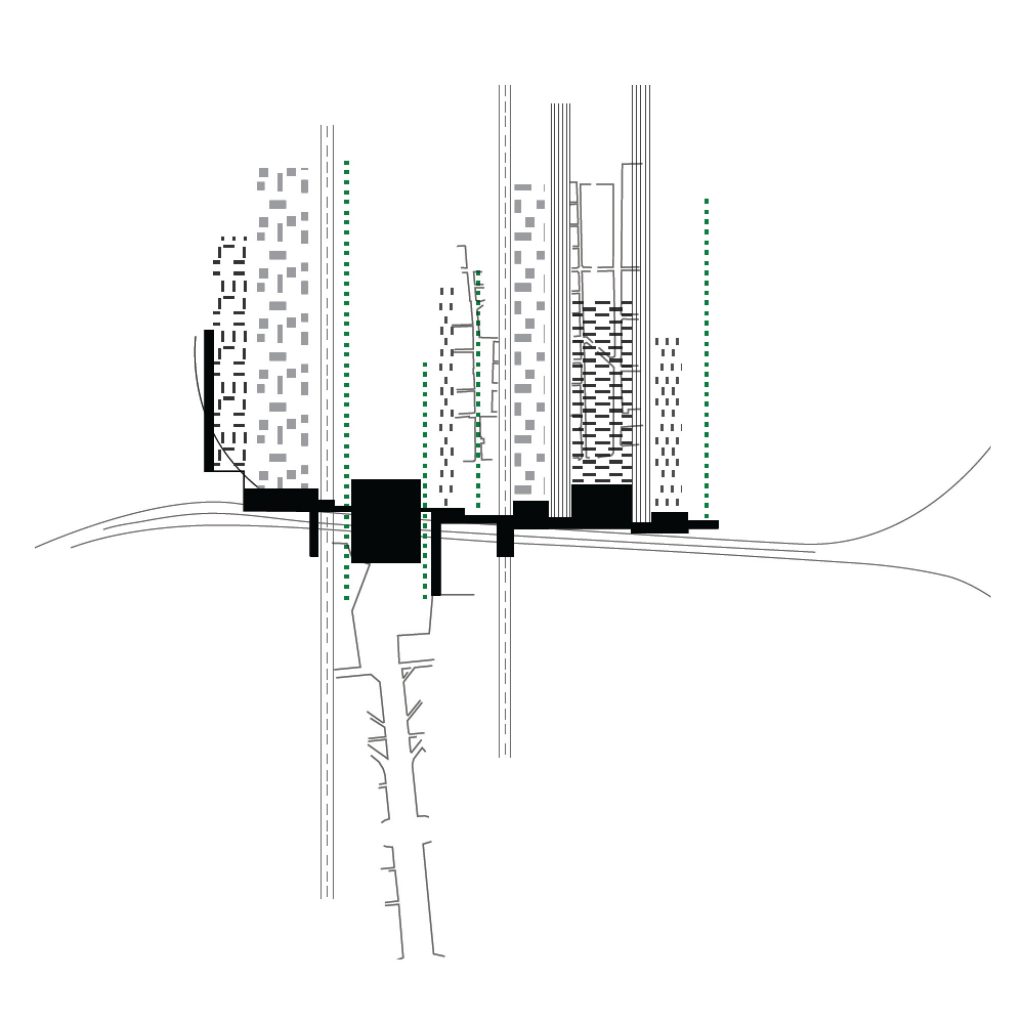
The city is generated through discrete measure — point, line, street, square — where space is articulated by interval, threshold and accumulation. Form emerges through separation and definition.
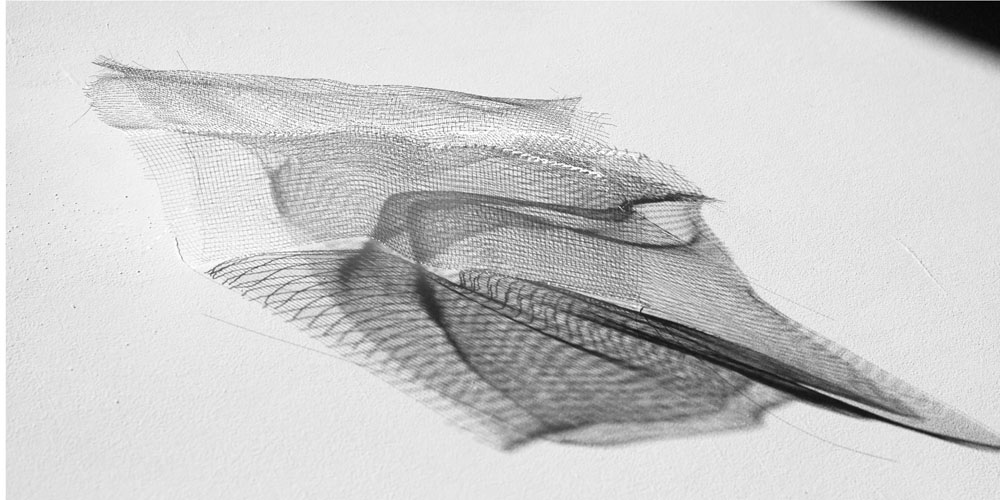
The landscape, conceived as a necessary infrastructure, operates through continuous measure: a field shaped by gradients, expansion and contraction, capable of accommodating variation within an overall coherence.
The waterfront becomes the space where these two regimes of measure intersect. Public space is redefined as a continuous surface of modulation, transforming the urban edge into a sequence where human activities and natural processes perform in dialogue.
Drawing from Rossini’s musical structure, rhythm and crescendo are translated into spatial intervals, material gradients and calibrated intensifications.
Music operates as a technical device through which measure, continuity and variation are articulated along a 2 km urban sequence.


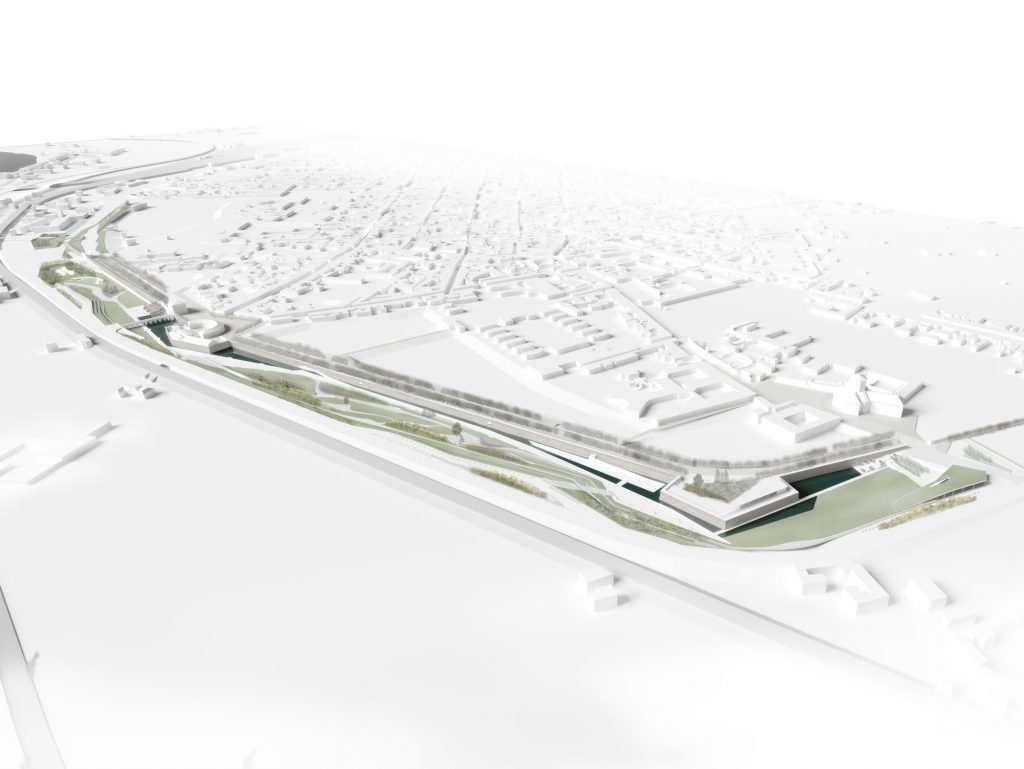
The proposal for the Pesaro waterfront originates from a confrontation between city and landscape as systems structured by different measures. The city is generated through discrete measure: point, line, street, square. Space is articulated by intervals, thresholds and successive additions. Urban form emerges through separation and definition, according to a logic of accumulation and distinction.
The landscape, conceived as a necessary infrastructure, operates through continuous measure. It unfolds as a dynamic field shaped by gradients, expansion and contraction. It absorbs variation without losing coherence.
The intervention constructs a unitary theme along the axis of Via Trieste. This theme expands and contracts in time and space, declining along the entire route. The different characterisations of places are brought into relation through a continuous design. The parts dialogue in transparency. Variation appears as a progressive modulation of intensity, use and perception.
The celebration of Rossini’s Opera becomes not only a recognisable and iconic element, capable of presenting Pesaro to visitors, but also a technical and structuring scan of space within continuity. The project seeks to translate into form — or rather into spatial narration — the compositional traits of Rossini’s music. His work is understood as harmony based on continuous variation, not as a discrete and fragmented succession of episodes.
The translation of music into space plays a fundamental role as a device of dialogue between urban space and landscape. The former can be designed in relation to the characteristic structure of the city as a “street–square” sequence, defined through measurable intervals. The latter is described through continuity and variation, expressing a different perception of rhythm.
Via Trieste is interpreted as a moment of threshold and dialogue between urban space and landscape. The project seeks an interaction that is not only visual, connecting foreground and background while conceptually linking the sea and the horizon with the inland territory.
Within this framework, the intervention is read as intrinsically connected to Pesaro and its territory. The waterfront and the beach are the places where the city manifests itself and gathers. Yet there exists a territorial depth, a value and a complexity that the project must acknowledge and narrate from a privileged point of view.
At the larger scale, the territory of Pesaro is imagined as a great theatre in which the parts are deeply interconnected. Via Trieste becomes the Stage. The sea and the sky form its natural scene.
Music and Rossini


Characterising Elements and Modes of Spatial Translation
Rossini’s music is assumed as the compositional grammar of the project. Its internal structure — founded on rhythm, variation, accumulation and intensification — becomes an operative model for constructing space. The relationship between city and landscape is reinterpreted through musical categories that guide measure, density and transformation.
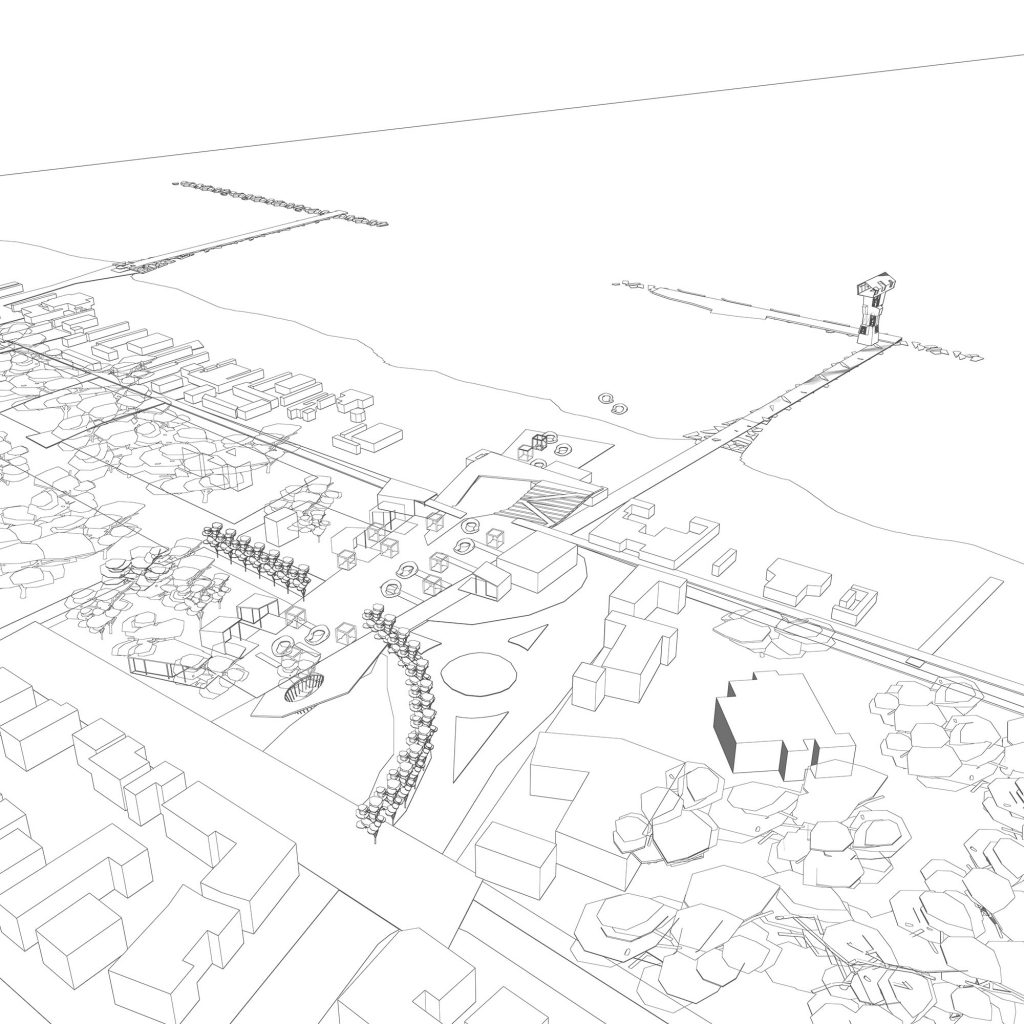
The northern waterfront, extending for approximately two kilometres, is conceived as a continuous urban score. The overall framework maintains structural coherence while internal intensities evolve progressively. Harmony emerges as the capacity to integrate variation and continuity within a unified field.
Continuity and Modulation
The principle of progressive addition, central to Rossini’s compositional language, becomes a spatial device. Crescendo is interpreted as a process of accumulation that transforms perception while preserving structural coherence. This mechanism is translated into the modulation of surfaces, vegetal density, permeability and light intensity.
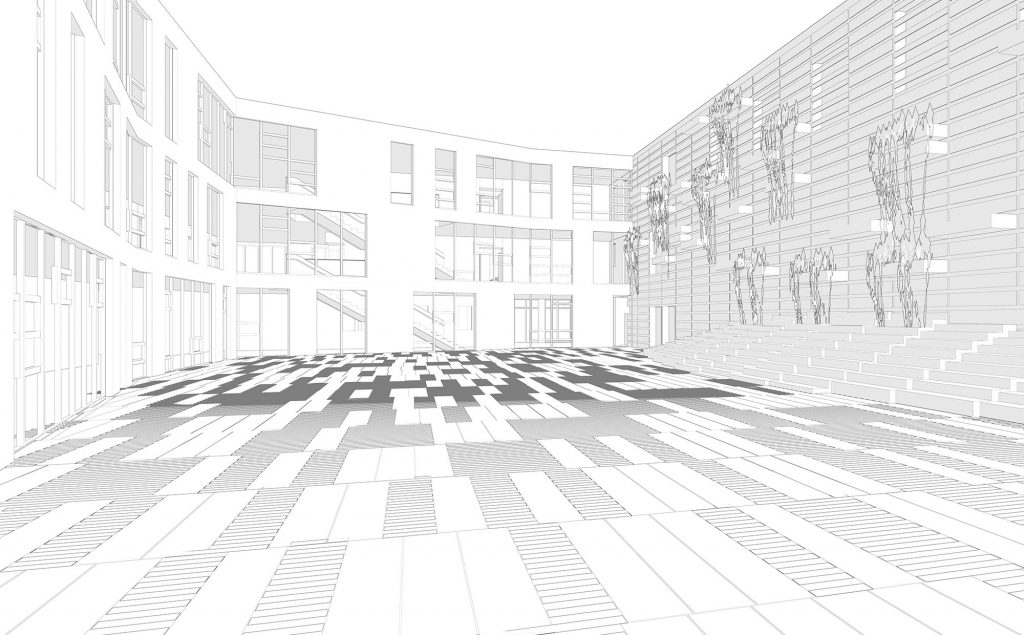
The pavement assumes the role of a visual score. The ground transforms along a gradient of permeability, moving from compact materials to drained and porous textures. Each element derives from the previous one and gradually modifies it, generating continuous transformation.
Melodic Line and Rhythmic Structure
The primary path is conceived as a melodic line running through the entire waterfront. Paving systems, street furniture, tree alignments and lighting devices follow a rhythmic cadence inspired by Rossini’s agogic structure. The perpendicular lines crossing the axis of Via Trieste assume a central role as beats and accents.
The spacing between these lines determines the tempo of space. Their material and visual intensity constructs differentiated perceptual modulations. The sequence generates a continuous pattern that accompanies movement and produces a corporeal sense of rhythm experienced through walking.
The musical score is thus translated into a spatial score. Visitors traverse a rhythmic structure that organises time, density and variation.
Episodes and Movements
The entire waterfront is articulated according to a structure inspired by operatic composition: Ouverture, moments of intensification, phases of release and closure. Each section assumes a specific spatial quality while maintaining the continuity of the route.
Resting areas function as arias or cavatinas, spaces of pause and concentration. Linear segments operate as recitatives, dynamic and connective. Collective open areas act as duets or choruses, sites of interaction and shared presence. Crescendo appears as progressive landscape and functional densification.
Geometry and Dynamics
Geometries privilege fluidity and variation. Lines open and close, solids alternate with voids, and visual openings towards the sea introduce dynamic tension comparable to operatic dramaturgy. The boundary between city and landscape is articulated in a porous manner, reinforcing overall unity.
Expansion and contraction regulate the sequence. Compact zones alternate with open and extended spaces. The route develops a phrased rhythm in which density and permeability vary while coherence is preserved.
Outcome
The result is a unified landscape-surface in continuous transformation. Materials, geometries and densities evolve according to a controlled and dynamic logic. Rhythm, variation, intensity and direction operate as instruments of spatial articulation.
The waterfront becomes a traversable score. Discrete urban measure and continuous landscape measure converge through modulation and rhythm, forming a coherent and identifiable landscape infrastructure.
Spatial Structuring, Materials and Typologies
The principles described above lead to the conception of a pulsating spatial field in which variations of character unfold in sequence, guided by the rhythmic structure derived from Rossini’s music. Space is organised as a continuous system of calibrated intensities, where shifts in density, materiality and openness follow a coherent modulation.
In response to climate change and the increasing frequency of extreme weather events, particular attention is given to the modulation of ground permeability. The project develops a sophisticated transition between compact pedestrian surfaces and fully drained natural ground, introducing at least two intermediate conditions. This layered gradient allows the ground to perform both structurally and environmentally, integrating accessibility, durability and water management within a unified design logic.
Within the spatial sequence defined above, the boundary between “nature” and “artifice” is articulated as a porous and nuanced threshold. The distinction between walkable surface and vegetated areas — at times intentionally irregular or less accessible — is not resolved through abrupt separation, but through gradual transformation. The result is a continuous dialogue between constructed and natural ground, reinforcing the overall coherence of the waterfront as an infrastructural landscape.
Programmatic Articulation and Landscape Character
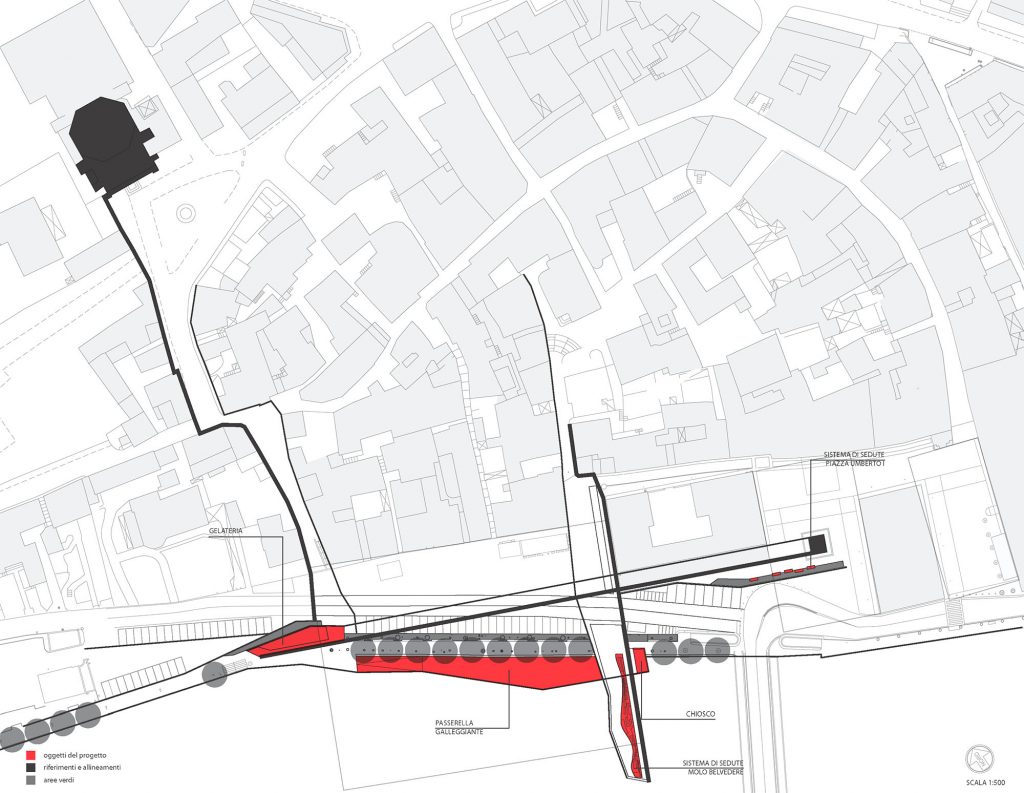
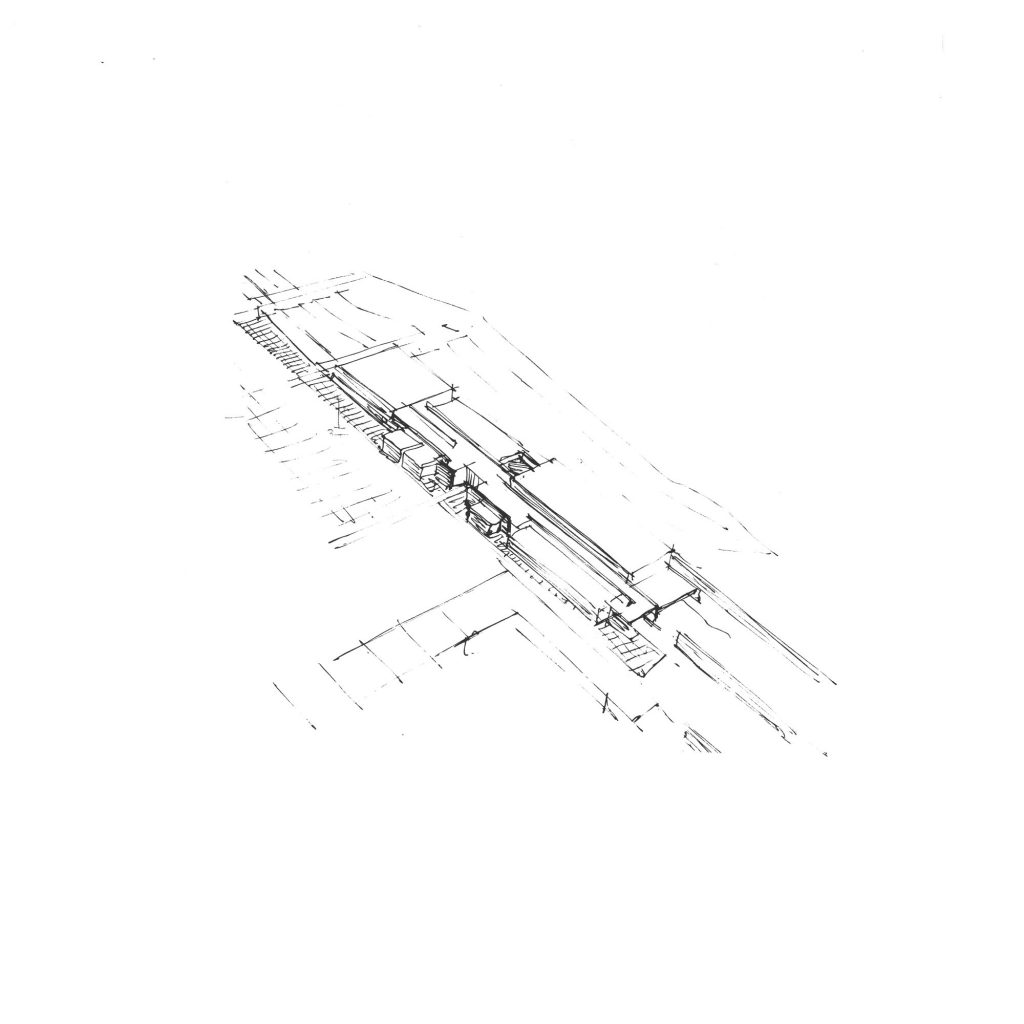
The spatial strategy extends to the articulation of public programs along the waterfront. Kiosks are conceived as lightweight and reversible structures, integrated within the rhythmic sequence of the ground rather than treated as autonomous objects. Their placement follows the logic of intensification and pause, reinforcing the alternation between movement and dwelling that structures the entire project.
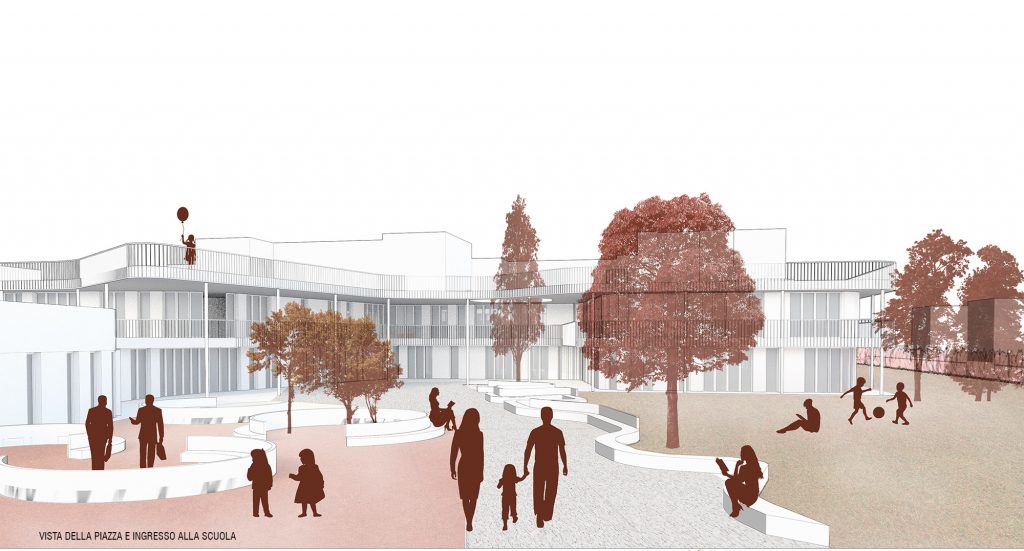
Squares and widened areas along the route are interpreted as moments of collective emphasis. These spaces do not interrupt continuity; they emerge from it. Each one assumes a specific civic vocation — gathering, performance, informal play, seasonal events — while remaining part of the continuous surface that defines the waterfront. The project avoids isolated plazas in favour of calibrated expansions within a coherent spatial field.
The vehicular carriageway and the bicycle lane maintain strong formal and material continuity with the pedestrian areas. Differences in use are defined through subtle variations of texture, width and marking rather than rigid separations. This approach reinforces pedestrian priority and frames the automobile as a temporary and secondary presence within a predominantly public and walkable landscape.
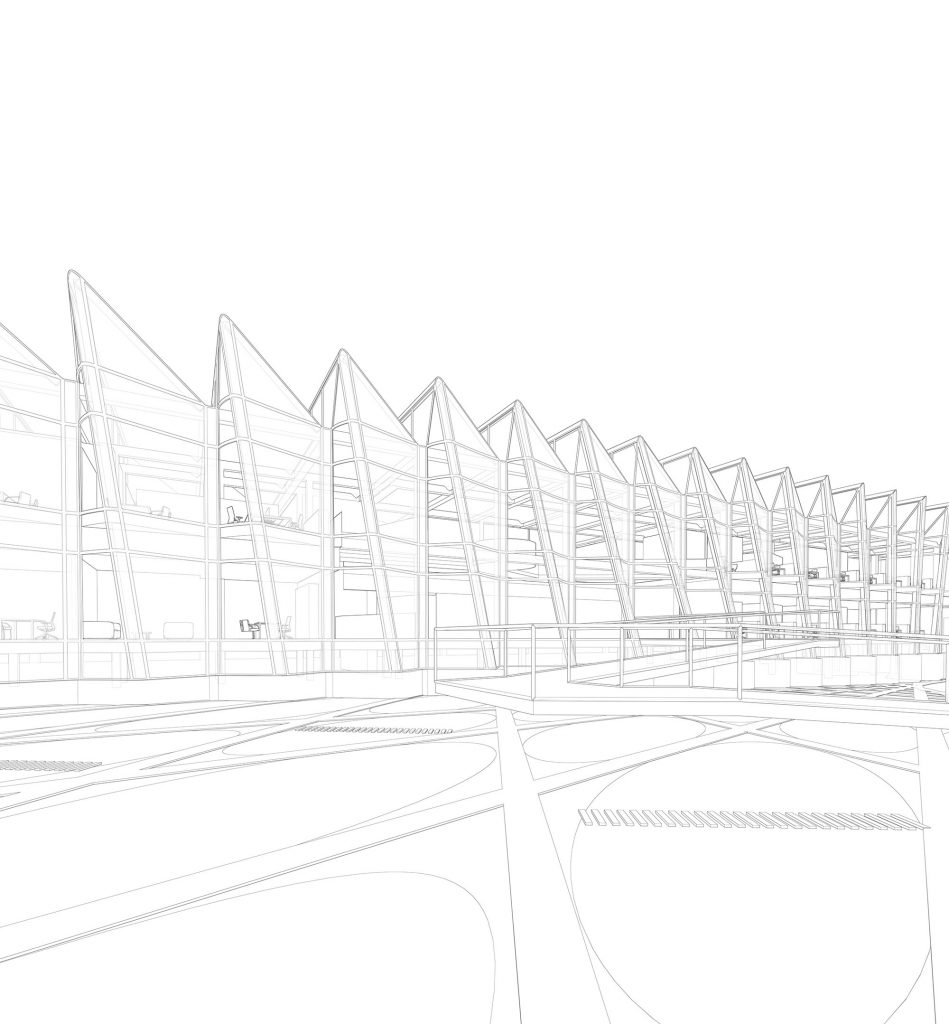
A compact multi-level parking structure is introduced as a necessary infrastructural component. Its position and form are calibrated to minimise visual impact and to preserve the spatial continuity of the waterfront sequence.
Botanical choices respond to both climatic resilience and spatial articulation. Existing tamarisks are preserved and integrated as structural elements of shade and rhythm. New plantings are selected for salt tolerance, wind resistance and low water demand. Vegetation operates as a modulatory device: denser in moments of intensification, more open in transitional areas. Species are arranged to reinforce gradients of permeability and to construct microclimatic comfort. The landscape is thus conceived as an adaptive system, capable of mediating between urban exposure and environmental conditions while contributing to the perceptual identity of the promenade.


Related projects