

Ground Studies
The relationship between grid and topography is a recurring theme within this research trajectory. It is not framed as an opposition, but as a dialogue between two modes of reading the ground and imagining principles of settlement in relation to it.


The grid stands as the matrix of rational settlements, from Hippodamus to Cerdà to Manhattan: a mental device that orders, measures, and abstracts.
Topography, by contrast, refers to a terrain shaped over time by the combined actions of nature and human modification. It links medieval settlements to more contemporary and “informal” configurations, rooted in the human scale and in the manual modifications through which land has historically been shaped. This polarity evokes long-standing cultural tensions between rational and empirical traditions, between Platonic and Aristotelian thought, and between geometric and picturesque approaches to landscape.
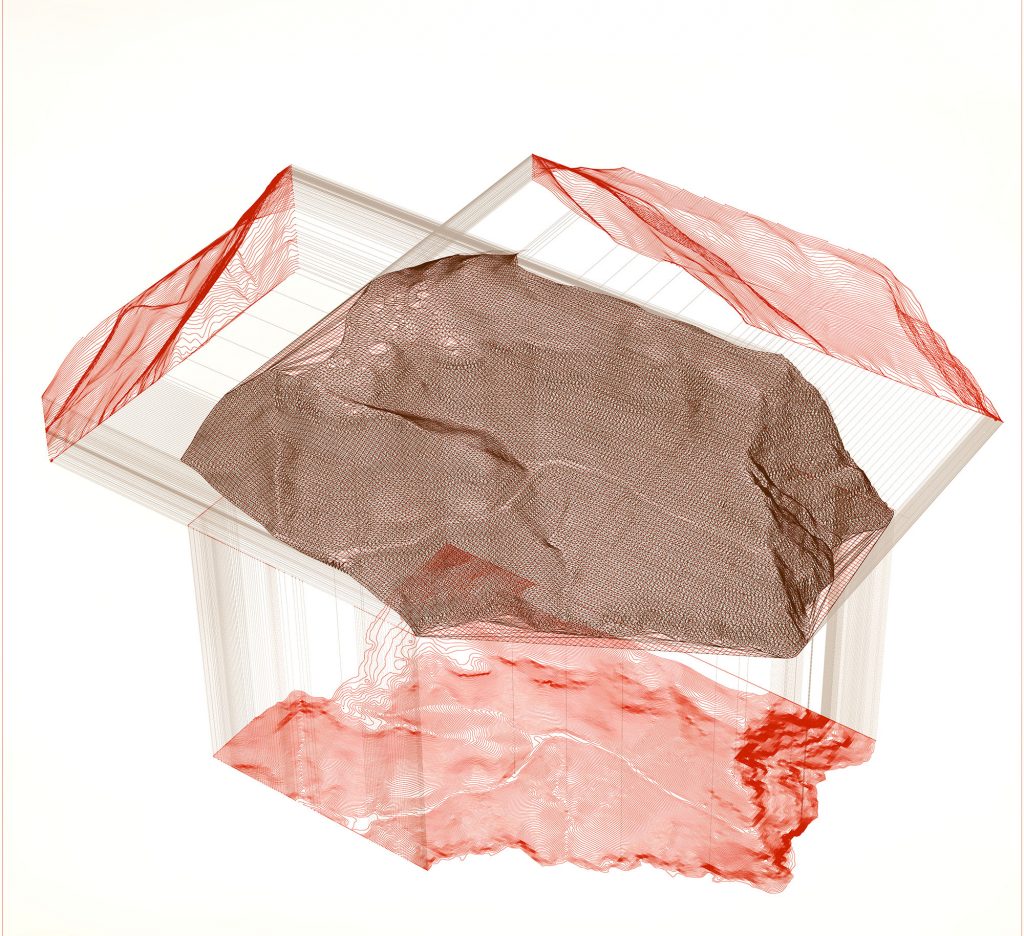
This study originates from the theoretical framework introduced in Design/Disegno and continues a line of inquiry resonant with Eisenman’s work from La Villette to Cannaregio. A geometric grid meets a shifting terrain: a series of squares that do not simply rest on the ground but cut into it, sink, and deform, altering their imprint and extrusion in accordance with each point of contact and its surface normal.
These minimal variations — almost annotations — open a broader reflection on how the ground is read, how layers interact, and how these investigations extend the recent research into the “transparency of the ground” developed over the past two years.
When rotated from horizontal to vertical, the terrain reveals different degrees of translucency, exposing the thickness of its layers and the light that filters through them.
Ground Studies


Related projects